
Why Wetpour Rubber Outperforms Sand and Rubber Tiles for Gauteng Schools
Choosing the right playground surface is a big decision. For Gauteng schools, it affects safety, budgets, and daily maintenance. Many principals still default to sand or rubber tiles. Both come with hidden costs. Wetpour rubber surfacing offers a smarter, longer-lasting alternative. This guide explains why it outperforms the competition.
The Hidden Costs of Sand on School Grounds
Sand feels like the cheap option upfront. Over time, that changes fast. Sand compacts under heavy foot traffic within months. Compacted sand loses its shock-absorbing properties almost entirely. That means falls become more dangerous, not less. Gauteng’s summer storms make sand worse. Heavy rain turns play areas into mud pits. Dry, windy months bring dust that irritates eyes and lungs. Schools also battle constant contamination in sandpits. Broken glass, animal waste, and litter collect easily in loose sand. Maintenance never really stops either. Staff must rake, top up, and rescreen sand regularly. Weeds grow through it if left untreated. The CPSC Public Playground Safety Handbook confirms that loose-fill surfaces need constant depth checks. Skip this, and impact protection drops sharply. For busy school grounds staff, that’s a difficult standard to maintain daily.
Why Rubber Tiles Fall Short Over Time
Rubber tiles sound like an upgrade from sand. In practice, they bring their own set of problems. Tiles have joints and seams between each piece. Those gaps trap dirt, moisture, and small stones. Over time, seams widen and edges curl up. This creates trip hazards on busy playgrounds. Learners running between activities can catch a shoe on a lifted edge. Wheelchair users struggle even more. According to a detailed ADA accessibility guide, tile joints can obstruct smooth wheelchair movement, even when the tiles meet the required specifications. Gauteng’s temperature swings also stress tile adhesives. Tiles are glued or interlocked onto a sub-base. Constant heat expansion and cold contraction weaken these bonds. Individual tiles can pop loose after just a few seasons. Replacing them means matching old colours to new stock, which rarely looks seamless.
What Makes Wetpour Rubber Different
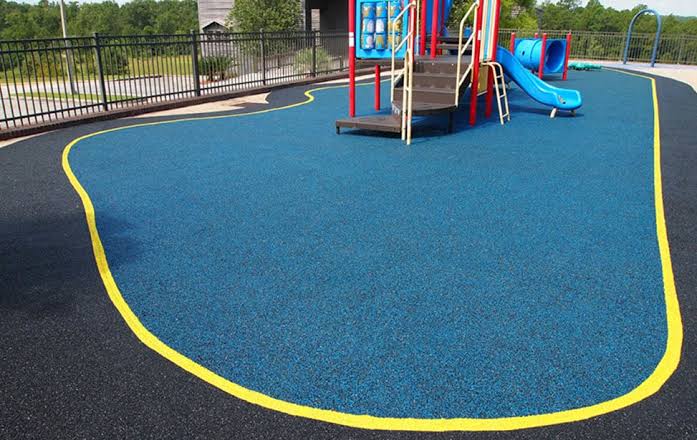
Wetpour rubber is poured and cured on-site as one continuous surface. There are no tiles, no joints, and no seams to fail. The base layer uses larger recycled rubber granules for shock absorption. A coloured top layer, usually EPDM granules, adds durability and UV resistance. Because it’s a monolithic surface, wetpour rubber moves as one unit. Thermal expansion doesn’t create gaps or lifting edges. This single-surface design is a major reason schools switch. It removes the weak points that plague both sand and tiles. Wetpour surfacing is also fully customisable. Installers can add school logos, sports court markings, or number grids. This turns a safety surface into an educational and branding tool. Few other surfacing types offer this level of design freedom.
Safety Performance That Meets International Standards
Safety is the top priority for any school surface. Wetpour rubber is engineered and tested against recognised impact standards. The EN 1177 standard sets out how surfacing must reduce fall-related head injuries. It defines a critical fall height for every surface thickness. Installers can adjust wetpour thickness to match equipment height. A taller jungle gym needs a thicker rubber base layer. This precision isn’t possible with sand, since depth erodes unevenly across a play area. Independent certification bodies, such as TÜV SÜD, test and certify wetpour systems against these impact requirements. Sand can technically pass impact tests when freshly installed and raked deep. Few schools have the staff capacity to maintain that depth daily. Wetpour rubber keeps its tested performance for years, with no daily upkeep required.
Built for Gauteng’s Climate
Gauteng schools deal with intense UV exposure, summer hail, and sudden downpours. Wetpour rubber is formulated to resist all three. The EPDM top layer is UV-stabilised, so colours don’t fade quickly under strong highveld sun. Drainage is another major advantage. Wetpour surfacing is laid on a permeable base. Rainwater passes straight through instead of pooling on top. This means playgrounds are usable again within minutes of a storm passing. Sand, by contrast, stays waterlogged and muddy for hours or even days. Hail is common in Gauteng’s summer storms. Wetpour rubber’s flexible, cushioned structure resists cracking from hail impact. Hard surfaces like concrete or worn tiles are far more prone to damage. This resilience protects the school’s investment through harsh weather seasons.
Accessibility and Inclusive Play
Inclusive education means every learner deserves equal access to play areas. Wheelchairs, walking frames, and crutches all need a flat, even surface. Wetpour rubber provides exactly that, with no seams or loose material underfoot. A Rocky Mountain ADA research summary found that poured-in-place rubber consistently scored well for firmness and stability. This matters for wheelchair rolling resistance over time. Sand offers almost none of this stability. Loose granules shift under wheels and walking aids, making movement exhausting. Rubber tiles perform better than sand here too. Still, their joints can catch small wheels and canes. A single continuous wetpour surface removes that risk entirely. For schools genuinely committed to inclusion, this is a meaningful difference.
Lower Lifetime Maintenance Costs
School budgets are tight, and every rand needs to work hard. Sand requires ongoing labour: raking, topping up, and screening out debris. Rubber tiles need periodic re-gluing, tile replacement, and seam repairs. Both come with recurring costs that add up over a decade. Wetpour rubber needs minimal upkeep by comparison. Occasional pressure washing and visual inspections are usually enough. There’s no material to replenish and no seams to reseal. Many schools find the higher upfront cost pays for itself within a few years. Longevity also matters for budgeting cycles. Wetpour rubber typically lasts 10 to 15 years with proper installation. Sand needs constant replenishment, and tiles often need partial replacement well before that.
Hygiene and Health Benefits
Sandpits are notoriously difficult to keep clean. They attract cats, insects, and litter between school hours. Bacteria and parasites can survive in damp, shaded sand for extended periods. This poses a real health risk for young children who play close to the ground. Wetpour rubber has a smooth, non-porous surface. It’s far easier to clean and doesn’t harbour the same contaminants. There’s also no dust generation, which benefits learners with asthma or allergies. For schools focused on learner wellbeing, this hygiene gap is significant.
Design Freedom for School Branding
Wetpour rubber isn’t just functional; it’s a design canvas. Schools can incorporate their crest, house colours, or mascot into the surface. Sports courts can include permanent, durable line markings for netball, basketball, or mini-soccer. Educational elements like number grids, alphabet paths, or hopscotch patterns are easy to add too. This flexibility helps schools create a distinct, welcoming play environment. It also reinforces school identity for open days, prize-givings, and marketing photography. Neither sand nor rubber tiles can match this creative range.
Sustainability: Recycled Rubber, Real Impact
Environmental responsibility matters more to schools every year. Wetpour rubber’s base layer is typically made from recycled tyre rubber. This diverts waste tyres from landfills and gives them a genuinely useful second life. For general background on how these systems are constructed, the Wikipedia entry on playground surfacing offers a helpful technical overview. Choosing wetpour rubber lets schools teach sustainability by example. Learners see recycled materials protecting them daily. That’s a practical lesson that textbooks alone can’t deliver.
Choosing the Right Installer
Not all wetpour installations perform equally well. Poor installation leads to premature cracking, uneven thickness, or drainage failures. Schools should ask for proof of correct base preparation and certified rubber granule sourcing. Request evidence of impact testing for the specific thickness used on-site. Experience with school environments matters too. High foot traffic areas need denser base layers than home gardens. An installer familiar with Gauteng’s climate will specify the right formulation from the start.
The Turfgreen Group Approach
Turfgreen Group specialises in wetpour rubber surfacing built for South African school conditions. Every installation is tailored to equipment height, expected traffic, and budget. The result is a safer, longer-lasting play area that needs far less ongoing attention than sand or rubber tiles. Investing in wetpour rubber protects learners and school budgets at the same time. It’s a decision that pays off for years, not just for one school term. Ready to upgrade your school’s play surface? Contact Turfgreen Group to discuss a wetpour rubber solution built for your grounds.
Recent Posts:
-
EPDM vs SBR: Understanding the Two Layers of a Wetpour Rubber Surface
-
SANS and EN 1177 Compliance: What South African Schools Should Ask Their Wetpour Installer
-
Instant Lawn for Sports Fields and School Grounds: Durability Under Heavy Foot Traffic
-
Hybrid Landscaping for Mixed-Use Estates: Combining Instant Lawn, Artificial Grass and Wetpour