
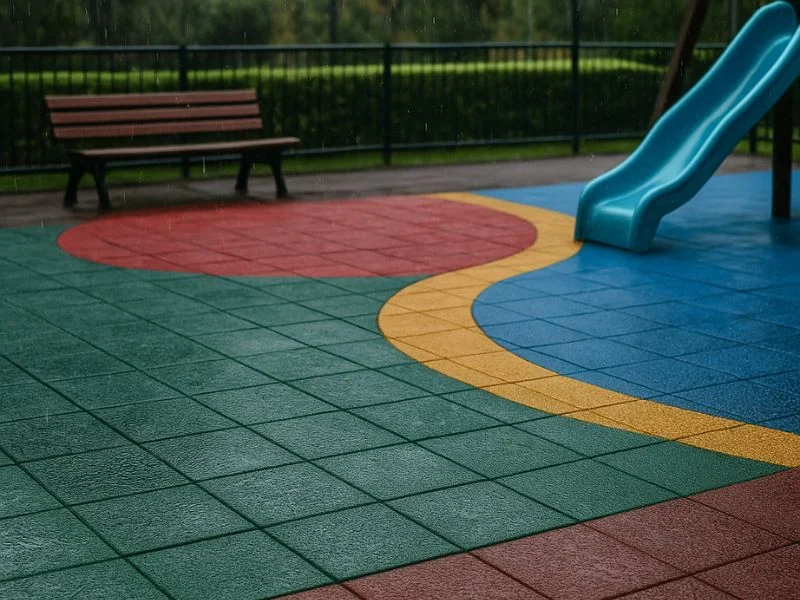
Wetpour Rubber Drainage: No More Pooling in Gauteng Storms
Gauteng’s summers bring drama. Blue skies turn to hail in minutes. As a result, playgrounds, sports courts, and school yards take the brunt of it. For any facility using wetpour rubber surfacing, drainage isn’t an afterthought. In fact, it’s the difference between a safe, all-weather surface and a slippery, waterlogged liability. Below, we explain how Turfgreen Group designs wetpour systems that shed Gauteng’s storms fast, without pooling, cracking, or losing their safety rating.
Why Gauteng’s Rainfall Pattern Matters for Surfacing
Gauteng sits in a summer rainfall region. Specifically, most precipitation falls as short, intense thunderstorms between October and March. The province is characterised by a pattern where precipitation mainly occurs as thunderstorms, reaching about 700mm annually. However, these aren’t gentle showers. Research on the region’s rainfall shows how sudden the intensity can be. For instance, a significant event is defined as more than 10mm in 24 hours, while a very heavy event exceeds 25mm. Some totals have been extreme. Indeed, the highest 24-hour rainfall recorded during a 32-year study period reached 300mm in December 2006. Consequently, this kind of downpour overwhelms poorly designed surfaces within minutes. Water has nowhere to go. Instead, it pools on flat, compacted, or non-porous ground. That standing water then becomes a slip hazard the moment the sun returns. Furthermore, local weather patterns confirm this isn’t a rare event. Severe thunderstorm warnings are now a regular feature of the Gauteng forecast each summer, as reported by Eyewitness News, with flood risk flagged for low-lying areas. Therefore, any surface specified for this climate must be built to drain, not just to look good.
What Makes Wetpour Rubber a Smart Choice for Wet Climates
Wetpour rubber is a seamless, in-situ poured surface. It’s made from rubber granules bonded with a polyurethane binder. Unlike tiles or loose-fill materials, it has no joints or gaps for water to collect in. Because of this seamless structure, the surface is naturally porous. Water passes through the surface itself, not just around it. Indeed, product data from NBS Source confirms this directly: wetpour offers a smooth, seamless finish, while its water-permeable properties ensure reliability and versatility. That permeability solves half the pooling problem. Meanwhile, the other half comes down to how the surface is built underneath.
The Real Work Happens Below the Surface
A beautiful wetpour finish means nothing without proper groundwork. After all, drainage performance is decided long before the rubber goes down. Three layers do the heavy lifting.
Sub-base preparation. First, a compacted stone sub-base sits beneath every wetpour installation. Detailed guidance from RTC’s wet pour sub-base specification sets this out clearly: the sub-base needs to be solid and free of weeds, with sufficient drainage built in. Additionally, the same specification notes that drainage holes may need drilling in a grid pattern where no existing drains are present.
Geotextile membranes. Next, a permeable membrane sits between the sub-soil and stone layer. This stops fines from migrating upward and clogging the porous structure over time. Otherwise, drainage performance quietly degrades every rainy season.
Fall and gradient. Finally, every wetpour surface needs a designed fall, usually a gentle 1-2% slope. This directs water toward drainage points instead of letting it sit. Notably, flat installations are the number one cause of pooling complaints on rubber surfaces.
Overall, get these three layers right, and Gauteng’s heaviest storms drain away within minutes of the rain stopping.
Designing for Standing Water: The Practical Checklist
Turfgreen Group approaches every wetpour project with drainage as the starting point, not an add-on. Here’s what that looks like on site.
Site survey first. To begin with, every installation starts by checking existing ground levels, soil type, and natural water flow. Since clay-heavy Highveld soils drain slowly, this must be planned around before laying anything.
Sub-base depth matched to conditions. Similarly, poorly draining ground needs a deeper stone layer. This gives water somewhere to disperse before it reaches the surface.
Perimeter drainage channels. Edging details also matter. For example, concrete haunching or French drains around the surface edge catch excess run-off during extreme storms.
Porosity testing before handover. Furthermore, any reputable installer checks infiltration rates once the surface is cured. This confirms the finished product actually performs as specified.
Regular maintenance planning. Even so, porous surfaces still need occasional cleaning. Otherwise, dust, pollen, and organic debris from nearby trees can clog surface pores over a few rainy seasons.
Standards That Guide Safe, Well-Drained Surfacing
Drainage and safety aren’t separate concerns. In fact, a surface that holds water also fails impact-absorption testing over time, because trapped moisture weakens the rubber-binder matrix. Two standards govern this locally and internationally. To start, South Africa applies SANS 51177, adapted from the European framework. Reporting from Construction World on a Port Elizabeth playground rollout confirms this link directly: the surfacing met stringent EU standards, since adopted by the South African Bureau of Standards, with installation according to SANS 51177. Beyond that, the underlying international standard is EN 1177. A detailed breakdown from Rubberco’s compliance guide explains its core purpose: the standard requires impact-attenuating surfaces under equipment with a fall height above 600mm, tested to a Head Injury Criterion below 1000. Ultimately, compliant wetpour must hold both its cushioning properties and its porosity throughout its lifespan. Therefore, drainage design isn’t cosmetic — it’s part of the safety specification itself.
Splash Zones and High-Traffic Areas Need Extra Attention
Some spaces face water challenges beyond rainfall alone. For instance, splash pads, pool surrounds, and shaded courtyards all hold moisture longer than open play areas. Even so, wetpour handles these environments well when specified correctly. Coverage from The Leamington Observer highlights this exact use case: splash parks suit wetpour well, because drainage can be built directly into the design, and the material won’t degrade like organic surfaces do. As a result, for Gauteng properties with water features, irrigation overspill, or heavy shade cover, this built-in drainage capacity is essential. After all, standard concrete or paving simply can’t compete on slip resistance once wet.
Common Pooling Mistakes Turfgreen Group Sees on Site
Poor drainage rarely comes from bad rubber. Instead, it comes from cut corners during installation. A few patterns show up again and again across Gauteng properties.
Skipping the fall gradient. Sometimes, contractors pour directly onto flat, existing concrete. Without a designed slope, water then has no route off the surface.
Undersized sub-base. Likewise, thin stone layers can’t handle Highveld storm volumes. Consequently, water backs up and resurfaces through the rubber during heavy events.
No perimeter drainage plan. Meanwhile, surfaces installed flush against walls or raised beds trap run-off with nowhere to escape.
Ignoring existing site drainage. Every property has natural water flow patterns. Yet installations that ignore these end up fighting the landscape instead of working with it.
Fortunately, each of these mistakes is preventable with proper site assessment before installation begins.
Why Professional Installation Matters More in High-Rainfall Regions
DIY wetpour kits exist, but Gauteng’s storm intensity leaves little margin for error. Indeed, a drainage mistake that seems minor in a dry climate becomes serious after a 25mm downpour in twenty minutes. Because of this, professional installers calculate fall gradients, test sub-soil permeability, and match sub-base depth to local conditions. This upfront engineering work, in turn, is what separates a surface that performs for fifteen years from one that pools and cracks within three. Overall, Turfgreen Group builds every wetpour project around Gauteng’s specific rainfall behaviour. That means deeper attention to sub-base design, drainage detailing, and standards compliance than a generic specification would require.
Getting Wetpour Right the First Time
Gauteng’s storms aren’t going anywhere. In fact, climate patterns suggest thunderstorm intensity across the Highveld will remain a defining seasonal feature for years to come. Fortunately, a well-engineered wetpour rubber surface turns that challenge into a non-issue. Water drains through the surface and away through a properly graded sub-base — no pooling, no slip risk, no compromise on safety compliance. Ultimately, that’s the standard worth specifying for schools, parks, sports facilities, and residential play areas across Gauteng. Turfgreen Group builds this rainfall reality into every installation, from the first site survey to the final porosity test.