
Critical Fall Height Explained: How Turfgreen Group Specs Wetpour for Play Equipment
Playground safety starts underground, not on the climbing frame. The most important number in any play area design isn’t the slide height. It’s the critical fall height of the surfacing beneath it. At Turfgreen Group, every wetpour installation begins with this single calculation. Get it wrong, and even the best-designed play equipment becomes a liability. Get it right, and children can fall, tumble, and misjudge a jump without serious injury. This guide explains what critical fall height actually means. It also shows exactly how Turfgreen Group specifies wetpour depth for every project we install.
What Is Critical Fall Height?
Critical fall height (CFH) is a precise engineering measurement. It defines the maximum height from which a child can fall onto a surface. Below that height, the impact should not cause a life-threatening head injury. Above it, the surface can no longer be trusted to absorb the energy safely. CFH is tested using a method set out in BS EN 1177, the European standard for playground surfacing. A weighted headform is dropped from increasing heights onto a test surface. Sensors measure the deceleration force at the moment of impact. This is expressed as a Head Injury Criterion (HIC) score. Once the HIC score passes 1000, the surface has exceeded its safe limit. The height just before that threshold becomes the certified critical fall height. This isn’t a rough estimate. It’s a certified, repeatable, laboratory-verified number. Every reputable wetpour supplier should be able to provide it for their product.
Why Critical Fall Height Matters for Every Playground
According to RoSPA, falls account for the majority of playground injuries. This makes surfacing the single biggest safety factor in any play area. EN 1176 is the equipment standard that works alongside EN 1177. Any structure with a free fall height above 600mm requires impact-absorbing surfacing. The maximum permitted free fall height on any playground is 3 metres. This creates a simple design rule. The certified critical fall height of your surfacing must equal or exceed the highest fall point on your equipment. If a climbing frame platform sits at 1.8 metres, the surfacing beneath it must be rated for at least 1.8 metres CFH. Anything less puts children at risk and puts operators at legal exposure. Insurers and courts increasingly treat these standards as the benchmark for reasonable care. A playground operator who cannot show a matching CFH certificate carries real liability. This is true even where compliance isn’t strictly mandated by law.
How Wetpour Achieves Its Critical Fall Height Rating
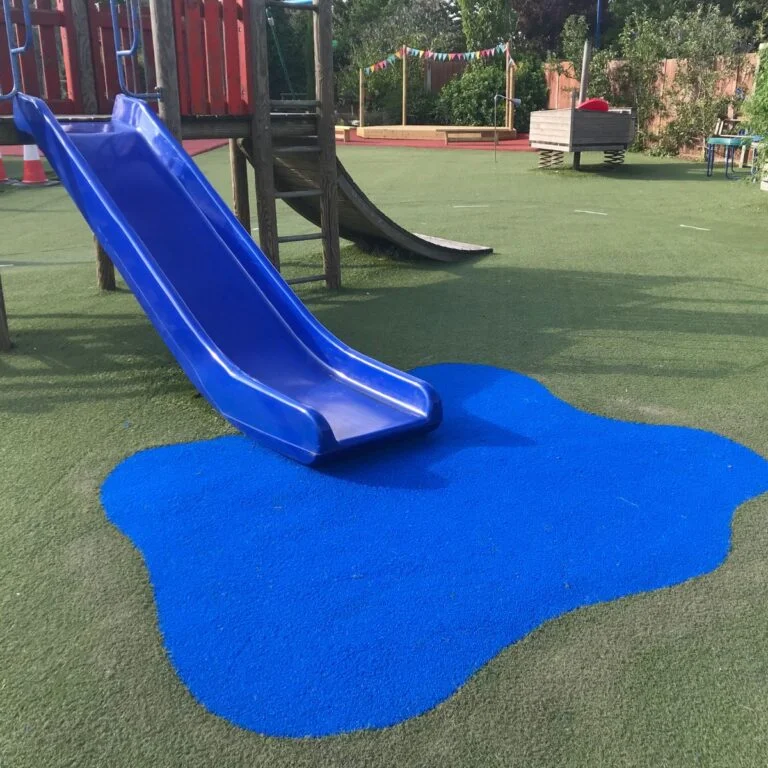
Wetpour, also known as poured-in-place rubber safety surfacing, works in two layers. The base layer is made of larger SBR rubber granules bound with polyurethane resin. This layer absorbs the bulk of impact energy through controlled compression. The top layer is a thinner EPDM rubber wear course. It provides colour, UV resistance, and a smooth, slip-resistant finish. The base layer thickness is what actually determines critical fall height. A thicker base layer means more air gaps within the rubber granules. This allows greater compression before an impact reaches the sub-base beneath. More compression means more energy absorbed, and a higher certified CFH. This is why wetpour depth is never a one-size-fits-all decision. A toddler swing with a 1-metre fall height needs a shallower base than a 2.5-metre climbing tower. Specifying the wrong depth either wastes budget on unnecessary material or, worse, leaves a genuine safety gap.
How Turfgreen Group Calculates Wetpour Depth
Every Turfgreen Group project starts with a site survey and an equipment audit. We don’t guess at depths from a generic chart. We measure.
Step one: identify the highest fall point. Our surveyors measure the highest designated play surface on every piece of equipment across the site. This includes platforms, monkey bars, and the tops of slides.
Step two: match fall height to base depth. We use manufacturer-certified test data for our specific wetpour system. This data links each base depth directly to a laboratory-confirmed critical fall height. A 30mm base might suit a low-level toddler unit. A 100mm-plus base is often required beneath taller combination units and towers.
Step three: account for sub-base and drainage. Depth alone doesn’t guarantee performance. A poorly prepared sub-base can undermine even a correctly specified wetpour depth. We build in permeable, free-draining foundations to keep the surface performing consistently in all weather.
Step four: document and certify. Every completed installation receives written confirmation of the critical fall height achieved. This paperwork matters. It’s what an inspector, insurer, or local authority will ask to see.
Common Mistakes in Wetpour Specification
Many playground refurbishment problems trace back to a mismatch between equipment and surfacing. A few patterns come up again and again.
Reusing old depth specifications for new equipment. Play equipment gets upgraded more often than the surfacing beneath it. Taller replacement units need deeper wetpour, not the original depth.
Ignoring “use zones” around equipment. CFH-rated surfacing must extend beyond the equipment itself. It needs to cover the whole area where a child might land after swinging, sliding, or jumping clear.
Assuming all wetpour products perform the same. Base layer quality, granule size, and binder ratio all affect real-world compression. Two products with the same stated depth can have different certified critical fall heights.
Skipping post-installation testing. Depth on a drawing is not the same as depth on the ground. Site conditions, compaction, and installation technique all affect the final result.
Turfgreen Group addresses each of these directly through site-specific specification, not generic templates.
Wetpour Versus Other Surfacing Options
Wetpour isn’t the only surfacing option for achieving critical fall height compliance. Loose-fill materials like bark, sand, and rubber mulch can also be tested for CFH. This includes standards such as ASTM F1292, used in markets that follow US guidance. However, loose-fill materials degrade over time. Wind, rain, and displacement from play reduce their depth and their protective performance. Wetpour holds its depth and its rating far more reliably. It doesn’t scatter, compact unevenly, or need regular top-ups to maintain its certified CFH. This makes ongoing compliance simpler for schools, councils, and private operators alike. The upfront cost is higher than loose-fill, but the long-term maintenance burden is significantly lower. For guidance on comparing surfacing types more broadly, the Register of Play Inspectors International (RPII) publishes independent inspection standards used across the play industry.
Maintaining Critical Fall Height After Installation
Critical fall height isn’t a one-time achievement. It needs ongoing attention to remain valid. Wetpour can lose depth through wear, especially in high-traffic areas like beneath swings and slide exits. Routine inspection should check for surface thinning, cracking, and delamination between the base and wear layers. The Health and Safety Executive recommends regular, documented inspections for all public play equipment and surfacing. A visual check should happen weekly. A more detailed operational inspection should happen monthly. An annual inspection, ideally from an independent RPII inspector, should confirm the surface still meets its original specification. Turfgreen Group offers post-installation maintenance checks. These are designed to catch depth loss before it becomes a compliance issue.
Frequently Asked Questions About Critical Fall Height
Does every playground need EN 1177-tested surfacing? Not legally, in most cases, if all equipment stays under 600mm free fall height. In practice, most public play areas include taller units. This makes certified surfacing the safer, more defensible choice.
Can I increase critical fall height without replacing the whole surface? Sometimes. Adding depth to an existing wetpour base can raise its rating, provided the wear layer and drainage are reinstalled correctly. A full site assessment is needed before assuming this will work.
How long does wetpour keep its critical fall height rating? A well-installed wetpour system typically holds its rating for eight to ten years. Heavy footfall areas may need earlier attention. Regular inspection is the only way to confirm ongoing performance.
Is a thicker wetpour base always safer? Not necessarily. Excess depth beyond what the equipment requires wastes budget without adding benefit. Matching depth precisely to the fall height is the more cost-effective approach.
Why Specification Expertise Matters More Than Price
Wetpour pricing varies enormously across suppliers. Much of that variation comes down to base depth and material quality, not just labour. A supplier quoting a shallower base than your equipment requires may look cheaper on paper. That saving disappears quickly if the surface fails an inspection or, worse, fails a child. Turfgreen Group prices every project against the correct specification, not a stripped-down alternative. Our quotes reflect the actual critical fall height your site needs. This approach protects schools, local authorities, and private clients from costly remedial work later. It also protects them from the reputational and legal fallout of a non-compliant playground. Specification expertise is the real value a competent contractor brings. Anyone can pour rubber granules and resin. Far fewer can calculate, document, and guarantee the resulting critical fall height with confidence.
Getting Wetpour Specification Right From the Start
Critical fall height is the number that determines whether a playground is genuinely safe. It isn’t a box-ticking exercise. It’s a calculation that protects children and protects the organisations responsible for their safety. Turfgreen Group builds every wetpour specification around this single principle. We start with the equipment, measure the real fall heights, and match base depth to certified performance data. We don’t rely on assumptions or industry averages. If you’re planning a new play area or replacing ageing equipment, get your surfacing specified properly first. A well-specified wetpour surface, correctly installed and maintained, gives every child a safer place to play. Contact Turfgreen Group to discuss a critical fall height assessment for your site. Our team will survey your equipment, confirm the required specification, and provide a certified wetpour solution built to last.
Recent Posts:
-
Instant Lawn Pricing in South Africa: What Affects Your Quote Per Square Metre
-
Why Wetpour Rubber Outperforms Sand and Rubber Tiles for Gauteng Schools
-
How Artificial Grass Copes With Gauteng’s Summer Thunderstorms and Drainage Needs
-
Colour and Design Options in Wetpour: Branding Playgrounds and Sports Courts